Fire Forged EnterprisePlant Performance Consulting

The FORGE OS Plant Alignment Program.

Six months. The first 90 days put maintenance and operations on the same plant goals, the same scorecard and the same daily meeting. The next 90 make it hold, with or without me in the room. We measure both.

FMonth 1

Fault Lines

Floor walks on both sides. Interviews from the ops manager to the operators. KPI baseline.

Validated cost of the gap

OMonth 2

Ownership

Leaders set the plant goals. Each side commits to what it will do and what it needs from the other.

Signed Alignment Charter, one joint scorecard

RMonth 3

Rigor

PM release paired with planned, kitted jobs. Operator basic care paired with technician cause reporting.

Habits in place. First results reviewed at day 90.

GMonths 4–5

Gain

Joint root cause on repeat failures and startup losses. Close the biggest losses. Coach supervisors through the hard months.

Measured improvement on your numbers

EMonth 6

Elevation

I step back and the plant runs it. Final measurement and a results review with your GM and CFO.

A results report and a plan to sustain it

The plant leader is my partner.

I don't do this to a plant. I do it with its leader.

  • Opens the kickoff and tells the plant it has full backing
  • Sets two or three plant goals and signs the Alignment Charter
  • Regular check-ins with me, clearing what's blocked
  • Leads the day-90 and final results reviews with me and the CFO
For the CFO

How results are measured

  1. Baseline from your systems.Month 1. Downtime, OEE, overtime and scrap pulled from your own records, not my estimates.
  2. Targets in writing.Each plant goal in the Alignment Charter carries a number. Example: Line 2 downtime from 6 hours a week to 3 by day 90.
  3. Tracked weekly.One joint scorecard, reviewed every week against the baseline.
  4. Reviewed at day 90, signed off at month 6.Results reviews with your GM and CFO. Cost per unit and payback, in their terms.

A plan, not a promise. The Diagnostic and the Alignment Charter give you a target. Your teams turn it into savings. I plan with you, teach, and course-correct, but the results come from engaged, aligned people on your floor doing the work. That is also why they last.

Is this the right fit for your plant?

Give me 30 minutes. Tell me what's happening between your two sides, and I'll tell you whether the full program fits or one focused project makes more sense.

Book a 30-minute walkthrough
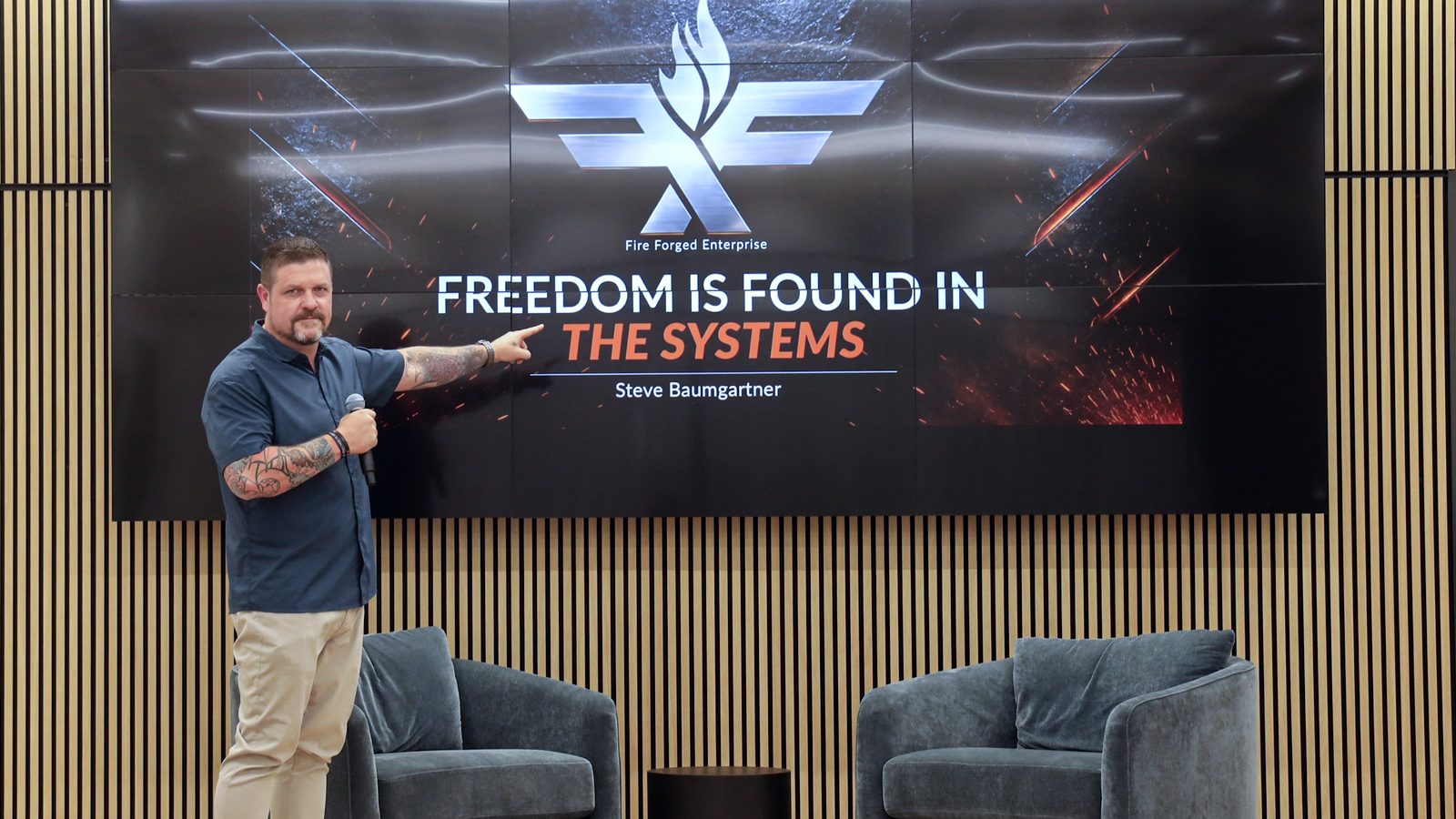
Steve Baumgartner on stage pointing to a slide that reads Freedom is found in the systems
The idea behind the workFreedom is found in the systems. Not in working harder. A plant that runs on shared systems doesn't need a hero on every shift.

The cost · Illustration

$30,340/wkExample plant, 150 people

Now picture the gap in your plant.

Brakebush was one line. Here is how the same gap usually adds up across a whole plant. The question isn't what outside help costs. It's what the gap costs every week you leave it open.

Example plant: where it shows upPer weekPer year
PM windows not released, so the line breaks down instead5 hrs/wk unplanned downtime × $2,500/hr$12,500$625,000
Scrap and rework after breakdowns, startups and changeovers$40M production × 3% scrap × 1/3 tied to equipment$8,000$400,000
Overtime spent chasing the schedule80 unplanned OT hrs/wk × $32 × 1.5$3,840$192,000
Turnover under untrained supervisors150 people × 40% turnover × $5,000 to replace$6,000$300,000
Total gap$30,340$1.52M
$0.38

Added to every unit shipped

$379K

A year back if you recover a quarter of the gap

$2,500

What one hour down on the bottleneck costs

Illustration only. Example plant: 150 people, $40M a year, 4 million units, 50 weeks. Turnover is priced at a conservative $5,000 per person.

See where your plant stands

Focused projects · each available on its own

Most plants know where it hurts. Start there.

Every number on your P&L traces back to the floor. When one area needs intensive focus, I'll work that area on its own: production, maintenance, training or a problem-solving workshop. Each one is a piece of FORGE OS, so it fits the full program when you're ready to close the whole gap.

Available on its own Part of FORGE OS: months 3 to 5, production side

Production Performance

Get more good product out of the same line.

For plant and production managers whose lines lose hours to slow startups, long changeovers, scrap and speed losses.

  • I find where the line loses time and product, and rank each loss by what it costs you.
  • Faster startups and changeovers, with maintenance in the room, so the line gets to rate sooner.
  • Standard work and centerlines, so every shift runs the line the same way.
  • A daily meeting and KPI board that surface problems the same day.
  • Root cause on repeat problems, done with your team, not for them.

Fixes the production side. FORGE OS closes the gap between both sides, and I factor this work in if you go on to the full program.

Talk through this project
Available on its own Part of FORGE OS: months 3 to 5, maintenance side

Maintenance Systems

Get out of firefighting and into planned work.

For maintenance and reliability managers whose crews spend the week reacting to breakdowns.

  • Planning and scheduling that holds, with jobs kitted before the window opens.
  • PM programs that actually work, and that production believes in.
  • Operator Driven Reliability: operators who own the health of their machines, working as partners with maintenance.
  • PM windows agreed with production, so they actually happen.

Fixes the maintenance side. FORGE OS closes the gap between both sides, and I factor this work in if you go on to the full program.

Talk through this project
Available on its own Part of FORGE OS: month 2

Training

Build the people who run it.

For supervisors promoted from the floor, planners and technicians who were never taught the job.

  • Frontline leadership: Lead Self, Lead Others, Lead the Business.
  • Planner and scheduler training.
  • PM and problem-solving training for leads and technicians.
  • Mostly on their own floor, production and maintenance in the same room.

Builds the people on both sides. FORGE OS puts them to work on the same plant goals.

See the training
Available on its own Part of FORGE OS: months 4 to 5

Problem-Solving Workshops

Solve a real problem, and learn the method doing it.

For plants with problems that keep coming back: the same breakdown, the same startup loss, the same scrap.

  • On site, working one of your real, repeat problems, not a classroom case.
  • Production and maintenance in the same room, owning the problem together.
  • Simple, proven root-cause tools your people can run without me.
  • You leave with the cause found, countermeasures with owners, and a follow-up date.

Solves one problem and teaches the method. FORGE OS makes it how the plant runs.

Talk through this project
Not sure where to start? · Part of FORGE OS: month 1

The Plant Gap Diagnostic finds it.

Two days on site watching both sides. Within a week: a written map of the gap, what it costs, and the first three fixes. I factor it in if you go on to the full program. After any project or the program, Coaching and Sustain keeps the gains from sliding back.

Book a 30-minute walkthrough

Every path starts with the same 30-minute call. I'll tell you whether you need one area or the whole program.

Where I work

A small number of plants at a time.

I take on a small number of plants at a time, so each one gets my full attention. These are the industries I've worked in.

  • Food, beverage and ag processing
  • Pulp, paper and packaging
  • Chemical and petrochemical
  • Mining, metals and fabrication
  • Equipment
  • Aerospace and defense
  • Consumer goods
  • The gap between maintenance and production looks the same in every plant.

Give me 30 minutes.

Tell me what's happening on your floor. You'll leave knowing whether the gap is worth a closer look and where I'd start. If it isn't worth closing, I'll tell you.